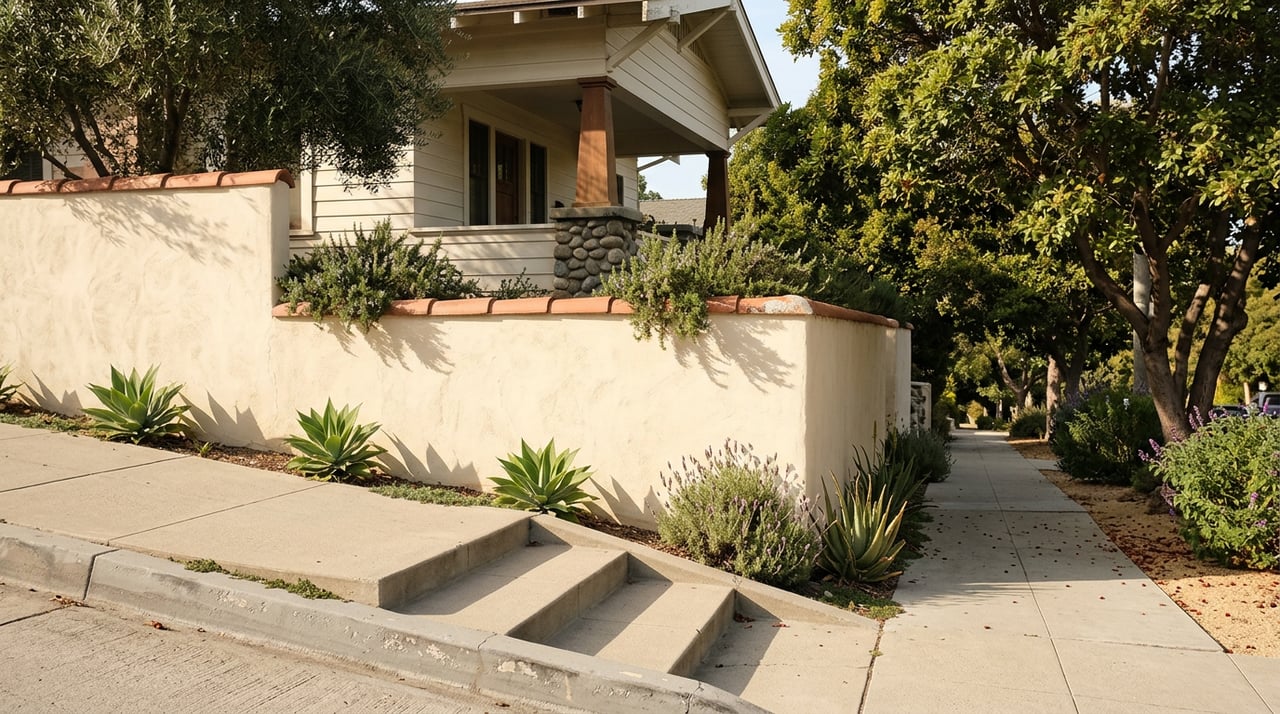
Walk south on India from Laurel and you are in Little Italy, which by any honest count now averages a new opening every few weeks. Walk north from Laurel, under the pedestrian bridge, past the trolley platform, and you are somewhere else entirely. The signs are older. The rents are quieter. The block belongs to Middletown.
This is a guide to the half-mile of India Street that sits on your side of the freeway, plus the two parks and one topiary garden that most residents forget are inside their walking radius. The argument is short: the piece of Interstate 5 that cut your neighborhood in half in the 1970s is the same reason your India Street still looks like itself.
The freeway did you a favor
When the state punched I-5 through the tidelands in the 1970s, it severed the historically Italian and Portuguese fishing community that stretched from the bayfront up the western hillside. The area east of the freeway rebranded as Little Italy and eventually became one of the densest restaurant corridors in California. The area west of the freeway kept the older name, kept the hillside bungalows, and kept a narrower commercial strip along India that never got a rebrand.
That is the strip you can walk to. It runs roughly from Washington Street south to about Winder, hemmed on the east by the I-5 sound wall and on the west by the slope up to Curlew and Union. It is one block wide. It has no farmers market, no bocce court, no branded arch. What it does have is a handful of operators who have been in place long enough that the neighborhood built around them, not the other way around.
The tourism guide version of India Street is Little Italy. The resident version, the one that starts at your front door and ends before the on-ramp, is a different block.
What "down the hill" actually means
For a Middletown resident on a street like Curlew, Union, or Reynard Way, "down the hill" is a fifteen to twenty minute round trip on foot. Here is what fits inside it, in the order you would hit them walking a loop from the residential streets down to India and back up:
- Harper's Topiary Garden, 3549 Union Street. Over fifty plant sculptures on a hillside front yard, all trimmed by hand. Edna Harper started it in 1994 after a Cape honeysuckle wandered in from a neighbor's yard. You cannot enter. You do not need to. Look from the sidewalk and keep moving.
- The Vine Street descent. Vine drops you from the ridge down to India in about two blocks. It is the shortcut locals use when they do not want to deal with the Washington Street traffic light.
- El Indio, 3695 India Street. Founded in August 1940 by Ralph Pesqueira Sr. at the corner of India and Grape as a tortilla factory that supplied local restaurants. Still hand-making corn tortillas. The taquitos are the thing.
- Shakespeare Pub & Grille, 3701 India Street. Directly opposite El Indio. Opened in 1990 by British expats and still one of a handful of places in the county pouring a cask-conditioned real ale off a beer engine. Head chef Thomas Beatty has been running the kitchen for years. The fish and chips were named best in the country in 2017.
- Gelato Vera Caffe. The Italian foothold that outlasted the freeway. Worth the detour on the way back up the hill.
- Starlite, 3175 India Street, at the southern edge of the walk. Opened in 2007, the interior by Bells & Whistles won an Orchid design award in 2009, and it was one of the first bars in Southern California to serve the Moscow Mule in a copper mug. Twenty-one and up, all hours.
- The pedestrian overpass at the bottom of the slope. If you want the trolley, this is where you cross I-5 to Kettner and the Middletown station. If you want to be back on your porch by dinner, you turn around here.
That is the loop. Under a mile of sidewalk, four buildings that have been operating for more than fifteen years each, and one that has been operating for eighty-five.
Three anchors, three different decades
The temptation is to read this stretch as a food strip. It is not. It is three separate businesses that opened in three different decades, survived three different downturns, and never got absorbed into whatever India Street was doing on the other side of the freeway.
| Anchor | Opened | What it started as | Still doing |
|---|---|---|---|
| El Indio | 1940 | Wholesale tortilla factory at India & Grape | Hand-making corn tortillas, plus a full menu |
| Shakespeare Pub & Grille | 1990 | British expat pub, English Tudor interior | Cask ale, scratch kitchen, quiz nights |
| Starlite | 2007 | Cocktail bar and design experiment | Artisan cocktails, late kitchen |
The Little Italy blocks a quarter mile south turn operators over on a much shorter clock. Sugarfish just opened on Columbia. Egg Tuck is coming into the Lindley. Those are fine additions to that neighborhood. They are also the exact churn that has not touched this side of the freeway. You can still walk into a room where the bartender remembers the last three people who lived in your house.
The green edges most residents forget
The walking radius runs the other direction too. Cross West Washington Street at the top of the hill and you are in Pioneer Park, which has a playground, a paved walking loop, and the shade of some of the oldest trees on this side of Old Town. Across from Pioneer sits Mission Hills Park, with its own set of trails. Together they form the northern edge of what a Middletown resident can reach without a car.
The neighborhood does not have a signature park inside its own boundary. It borrows two, both about the same distance as the India Street strip, in the opposite direction. A useful mental map of the radius is a rough T: India Street south and down the hill, Pioneer and Mission Hills Park north across Washington, home in the middle on the ridge.
Why this stretch does not turn over
Here is the argument, and the reason a guide to this half-mile is worth writing at all.
Retail turnover on a commercial strip is a function of foot traffic, rent, and adjacency. The India Street corridor south of Laurel has all three in abundance, which is why Little Italy is now an import market for LA and New York concepts. The India Street corridor north of Laurel has a freeway on one side, a residential hill on the other, and a pedestrian bridge as its only meaningful connection to the denser district. Foot traffic is real but capped. Rents are lower. Adjacency to national money is broken by six lanes of asphalt.
That combination is what an operator like Shakespeare needs to stay in the same building for thirty-five years. It is also what an operator like El Indio needed to survive from 1940 through the I-5 construction that literally reshaped the block around it. The same wall that cuts you off from Little Italy's Saturday farmers market is what keeps a tortilla factory from being replaced by a national omakase counter.
For a resident, the practical implication is small and useful. The businesses you can walk to now are the businesses you will probably still be able to walk to in five years. Very few blocks in central San Diego can make that claim honestly. This one can, and the reason has more to do with 1970s highway engineering than with anything anyone is doing on India Street today.
The neighborhood was named Middletown in 1850 because it sat between Old Town and what was then the emerging downtown. It is still in the middle. Between Little Italy and Mission Hills. Between the ridge and the bay. Between the block you can walk to and the one on the other side of the wall. Most residents treat the wall as a limit. It is closer to a moat.
If you own a home on the hill and you have been thinking about how the character of your block holds up over the next cycle, the answer usually starts with what your walking radius actually contains. Emerson Group works with owners and investors across central San Diego neighborhoods, and we are happy to talk through what a Middletown position looks like on a longer horizon. Schedule a Wealth Call when you want the numbers behind the walk.