Drive south on Union Street toward the intersection with Vine and the hillside changes shape without warning. Shrubs that should be shrubs are suddenly an elephant, then a whale, then something that might be a dinosaur or might just be an ambitious hedge having a moment. Cars slow down here in a way they don't slow down anywhere else on this stretch of Middletown. Nobody honks. People just look.
This is Harper's Topiary Garden, a private front yard at 3549 Union Street that has been quietly reshaping a hillside since the 1990s, and it is one of the few pieces of this neighborhood's daily texture that has never needed a grant, a nonprofit board, a ribbon cutting, or a reopening date. It has just needed one couple with a pair of pruning shears and a lot of patience.
One Couple's Yard, Not a Park
The origin story is smaller and stranger than the finished product suggests. According to Wikipedia's account of the garden, Edna Harper started the project in 1994 after noticing a Cape honeysuckle vine that had crept into her yard from a neighbor's garden. Instead of pulling it out, she looked at it and saw an elephant. From there, inspired by trips she and her husband Alex had taken, the vines and shrubs kept becoming other things.
There is no admission fee and no posted hours, because there is no attraction here in the official sense. It is a residential front yard that happens to contain a menagerie. A gardener maintains the collection on a near-daily basis, and one visitor account puts the upkeep at more than five hours a day, which tells you this isn't a weekend hobby that got out of hand. It is a full standing commitment, year after year, with no public funding attached to any of it.
That distinction matters more than it sounds like it should. Compare it to something like the Hillcrest farmers market, whose long-delayed return to Normal Street has depended on construction timelines, underground infrastructure, and a sequence of dates that kept moving. Public amenities live and die by budgets, permits, and committees. Harper's Topiary Garden answers to none of that. It exists because two people decided it should, and it will keep existing for exactly as long as they keep deciding that.
Fifty Sculptures, One Ongoing Argument With a Hedge
The current count sits above 50 individual figures, all shaped by hand rather than grown around wire frames, which is part of what makes the shapes look a little soft at the edges instead of crisp like a formal English topiary. Atlas Obscura's rundown of the collection lists pyramids, a dinosaur, a Buddha, a whale, an entire herd of elephants, and even a figure meant to represent the gardener who helps keep the whole thing alive.
Walk the sidewalk slowly and a few more details turn up. Wanderlog notes a Little Free Library tucked into the scene nearby, wrapped in bougainvillea, so the stop doubles as a place to trade a paperback if you happen to be walking with one. None of this is signed or explained. You are meant to look, guess, and move on, which is exactly why regulars describe the fun of it as trying to identify each shape before someone in the car behind you loses patience.
Ask around the neighborhood long enough and you will hear Edna referred to by a nickname that Axios San Diego used when the outlet flagged the garden in a February 2025 roundup: Edna Scissorhands. It fits. The Edward Scissorhands comparison shows up often enough in local writeups about the garden that it has become the shorthand people reach for first.
Nobody Fully Agrees Whose Neighborhood This Is
Here is the part that actually surprised me while digging into this. Ask five sources where the garden sits and you will get closer to three or four different answers.
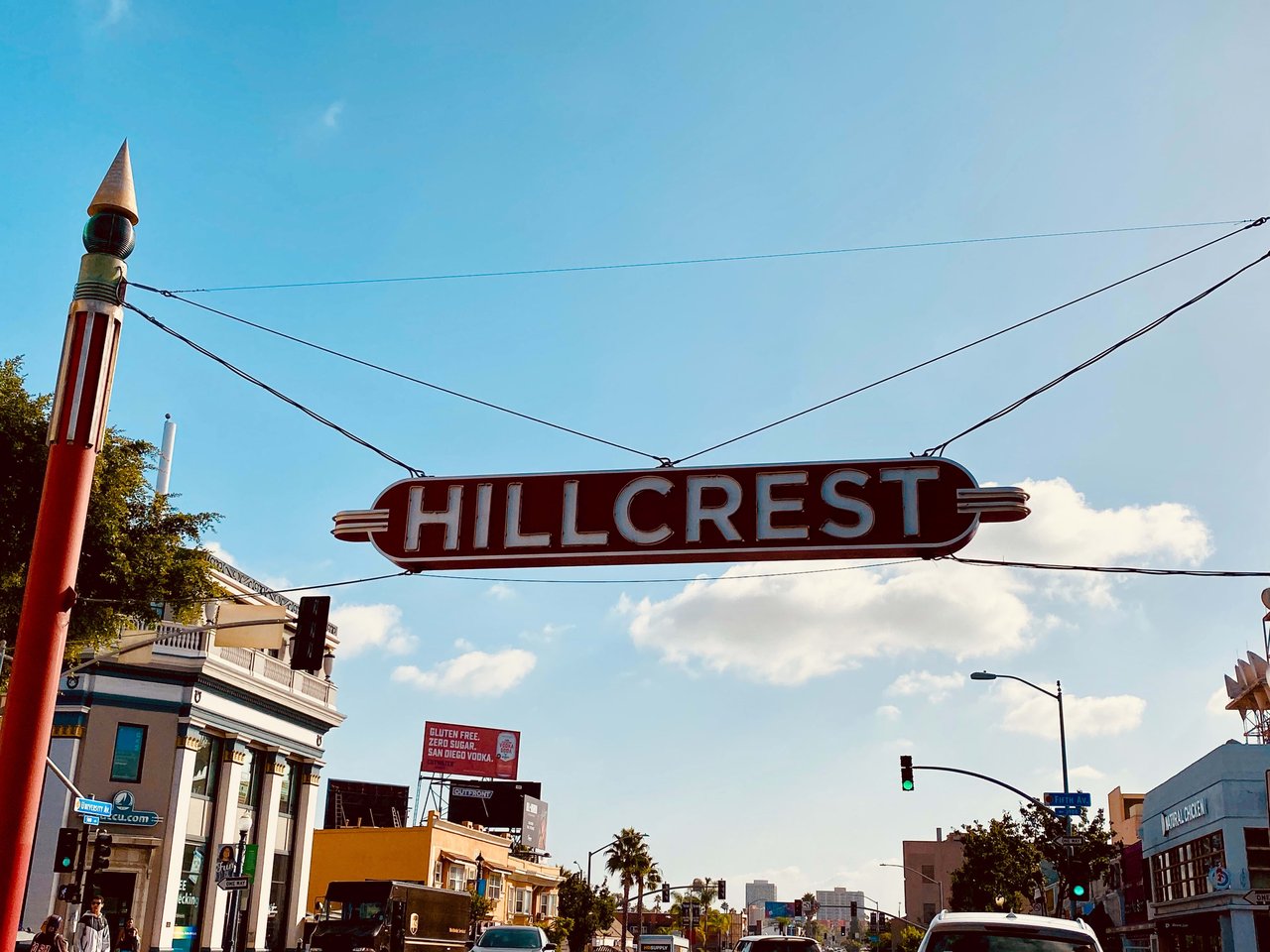
Wikipedia's entry places it squarely in Middletown. Roadside America's directions describe the location as a few blocks east of Interstate 5 and south of Washington Street, on the east side of Union at its intersection with Vine, which lines up with the Middletown side of the boundary. But other write-ups, including a couple of the more polished visitor guides to the garden, describe it as sitting in Mission Hills instead. And on Yelp, one longtime reviewer summed up the confusion better than any planning document could, wondering aloud whether the corner belonged to Hillcrest, Mission Hills, or Bankers Hill, before admitting they genuinely weren't sure.
Part of the reason for the disagreement is that Edna Harper herself has been described in some accounts as a Mission Hills resident, even though the address her garden occupies reads as Middletown by the neighborhood's official boundary. Hillside streets in this part of the city were never drawn with topiary gardens in mind. Union, Vine, Washington, and the slope between them sit close enough to four different neighborhood identities that a single front yard can plausibly belong to more than one of them depending on which map, which era, or which longtime resident you ask.
If you already live nearby, you already know this kind of boundary fuzziness is normal here. It shows up in casual conversation more than it shows up on any city document, and a garden that has outlasted three decades of shifting local identity is as good an illustration of that as anything else on this hillside.
Why It Has Never Needed a Permit
This is the part worth sitting with. Almost every other notable feature of daily life in this stretch of San Diego eventually intersects with some kind of institutional process. Restaurants need liquor licenses. Street fairs need city permits and road closures. Farmers markets need vendor agreements and, apparently, working sewer infrastructure before they can reopen. Even murals often go through a formal commissioning process with a named artist and a dedication date.
Harper's Topiary Garden has none of that, because it was never public in the first place. It is private property, maintained at private expense, on a schedule set by nobody but the people who live there. That is exactly why it has been able to survive unchanged in its essentials for more than 30 years while so much else on nearby commercial strips has opened, closed, rebranded, or waited on a permit. There is no lease to renew, no board to satisfy, no funding cycle to survive. The only thing keeping it going is a couple who kept deciding to keep going.
If you have lived in Middletown for any real stretch of time, you have probably already worked out that this kind of small, stubborn, privately sustained landmark tends to outlast almost everything built with an opening-day press release. This garden is a clean example of that pattern, sitting in plain view at a stop sign most people drive through without a second thought.
Seeing It Without Becoming the Reason It Closes
A few practical notes, since the garden's continued openness depends entirely on visitors behaving like guests rather than tourists at an attraction.
- It's a private residence. Admire from the sidewalk along Union or Vine. Entering the yard is not permitted.
- Street parking is generally available on both weekdays and weekends, so there's rarely a need to block a driveway or double park.
- Keep it brief and quiet. Most visits run five to ten minutes, long enough to spot the whale, the elephants, and whatever new shape has appeared since your last pass.
- If you're building a longer walk out of the visit, the garden pairs naturally with a stroll toward Presidio Park or down toward the India Street corridor, both an easy distance from this corner.
None of this requires an itinerary. It requires slowing down at a corner you've probably already driven past a hundred times without noticing what was growing there.
The Corner That Doesn't Need You to Agree on Anything
Whether you file this corner under Middletown, Mission Hills, or somewhere in between, the garden itself doesn't seem to care what the map says. It has kept growing regardless of which neighborhood claimed it that decade, and it will likely keep growing after the next boundary argument too. That kind of quiet permanence is rare in a part of the city where so much else changes with the lease.
If you're already living in this stretch of San Diego and want a deeper sense of what else sits within easy walking distance, our Middletown neighborhood guide is a good place to keep exploring, and our walking radius guide to the India Street corridor rounds out the rest of the neighborhood's daily rhythm. And if a conversation about this hillside ever turns from a walk to a move, Emerson Group knows this stretch of San Diego block by block and is always happy to talk through what a home here is actually worth.