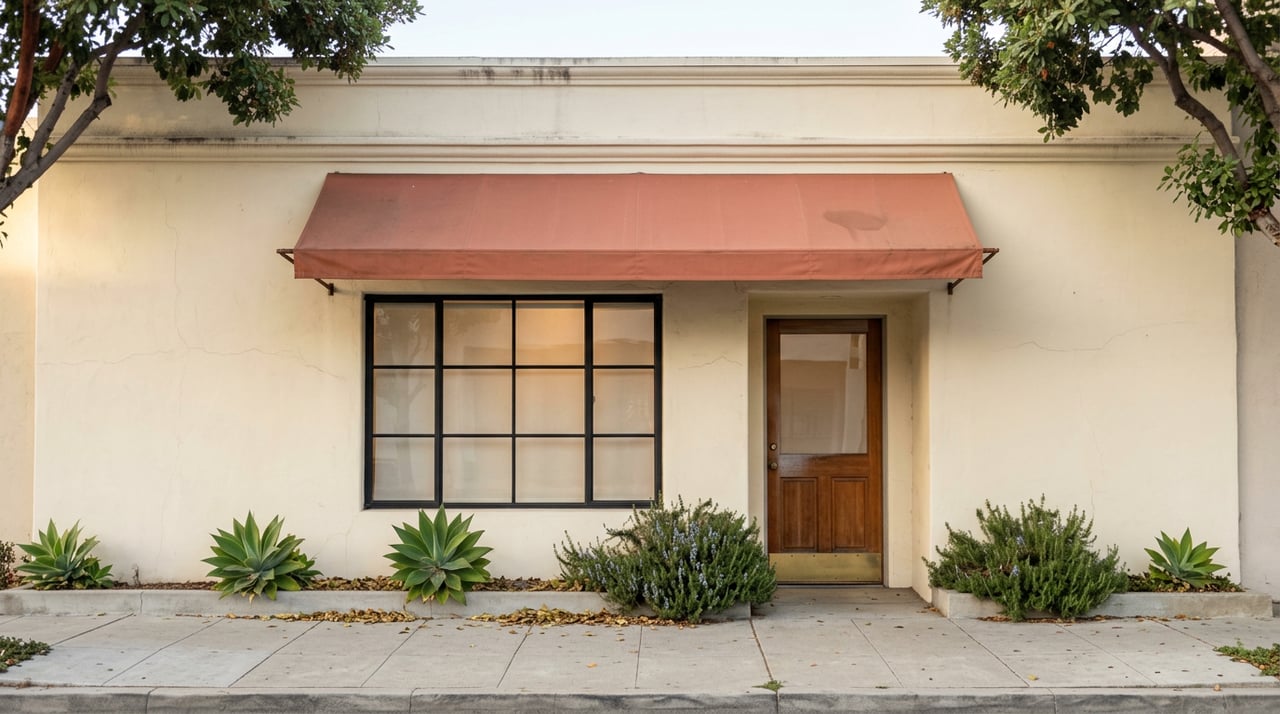
Anyone who has walked or driven the 4000 block of Adams Avenue in the last year has seen it. The same red neon lettering that has hung over that sidewalk since 1946 now spells out a message the theater never used in its 74 years of screenings. Coming Soon. The Ken. Community Suites. No movie times. No marquee joke about a midnight Rocky Horror showing or a Fellini retrospective. Just a promise, still unfulfilled the last time local reporters checked in.
The building at 4061 Adams Ave sat dark for five years after Landmark Theatres pulled out in March 2020, and the argument over what should replace it split the neighborhood into two camps that each assumed they were the only option on the table. What actually moved in behind that marquee is neither one.
Two visions, and neither one won
Landmark's exit in 2020 wasn't the Ken's first brush with closure. In 2014 the chain threatened to shut the theater down and only backed off after fans made enough noise to force a new lease. This time there was no reprieve, and the fight shifted from keeping the lease alive to controlling the building itself.
Neighborhood historian and preservationist Maggie McCann led an effort among Kensington residents to buy the property outright, going as far as preparing to form a limited liability partnership to head off the outcome they feared most: a developer buying the site and stacking a mixed-use, multi-story complex on top of it. Parking, already tight on that stretch of Adams, was the recurring worry, along with what a taller building would do to a block still defined by its 1940s storefronts.
Not everyone in real estate agreed preservation was the right call. Doug Lister, a local agent and former Rolando Community Council president, argued publicly that multi-story housing was exactly what the site should have become, a position that put him at odds with the preservation camp but reflected a real tension in how mid-city corridors like this one get valued. Land use against land memory.
Neither side got what it argued for. The building didn't turn into a resident-owned museum piece, and it didn't turn into housing either.
What Tom Frenkel bought, and what the Mills Act made possible
Tom Frenkel, founder and CEO of the Scottsdale-based Clayton Companies, closed on the Ken and its two adjoining storefronts, The Haven Pizzeria and Trattoria de Sofia, for $3.85 million in the final weeks of 2022. He isn't a first-time restorer. Clayton Companies has developed roughly 75 projects, mostly in Scottsdale, and Frenkel has described his approach as generational investment: build it, hold it, keep it in the family for decades instead of flipping it.
What made a 300-seat theater with a dead business model pencil out for him wasn't the auditorium. It was the facade. Frenkel's team is restoring the Ken's character-defining features under the Mills Act, the California program that grants property tax relief to owners who commit to preserving a historic structure's exterior. That single mechanism is why the marquee, the sandstone facade, and the ticket booth were never on the table for demolition, even as the interior behind them was gutted to the studs.
Construction crews didn't break ground until late May 2025, roughly two and a half years after the sale closed. Once they got in, the timeline moved fast. By that July, a site visit reported in the San Diego Reader found the screen and seats gone, the walls stripped, the floor dug out, and a cinderblock barrier splitting what used to be the auditorium.
What's staying, and what already left
- Gone: the movie screen, the theater seats, the original floor grade, the wall finishes down to bare studs.
- Staying: the marquee and its lettering, the sandstone facade, the ticket window, the building's original footprint and scale.
- Repurposed rather than removed: the auditorium's curved decking, left exposed on the new ceiling and punctuated with skylights, with some sections pulled down and reused as flooring elsewhere in the building.
- Reinstalled as a fixture, not a relic: the Ken's original film projector, mounted on a wall where it once ran reels for the last theater in San Diego still using carbon-arc projection.
That marquee lettering couldn't just be reordered from a catalog. The original typeface isn't made anymore, so Frenkel special-ordered a faithful reproduction from Wagner Letter Company to keep the sign reading the way Kensington remembers it, even while it now advertises tenants who have never sold a movie ticket.
Rob Mudd, general contractor with Element Design Build Inc., put the project in plainer terms after five years of walking past a locked building:
This building has been empty for five years. Now, we get to bring in a new life.
What actually moves in
Frenkel's plan calls for eight to ten businesses inside what used to be one screening room, arranged around a new mezzanine that adds a second story of suites in the space closest to where the old screen stood. He's said he's aiming for professional offices, wellness practices, and small businesses, the kind of tenants who benefit from being a five-minute walk from the rest of the Adams Avenue strip rather than needing destination foot traffic of their own. A new entrance is planned on the building's west side specifically to give multiple tenants their own access instead of funneling everyone through the original lobby doors.
As of last fall, no tenants had been announced. Frenkel has said the suites will be priced in line with creative office space elsewhere in the city, and that he intends to build out each space around the Ken's existing bones rather than the other way around.
McCann, who once organized to buy the building outright, has landed somewhere between relief and reserved judgment. Asked about the direction the project has taken, her verdict was measured: it could turn out to be the best non-theater use anyone could ask for, provided the promises hold.
Why this matters if you don't care about real estate
The Ken sits inside the two and a half mile stretch of Adams Avenue that the Adams Avenue Business Association manages as a single commercial corridor, running from Vista Street in Kensington through Normal Heights to Arizona Street in University Heights. It's the same stretch that fills up every fall for the Adams Avenue Street Fair and every spring for Adams Unplugged, the walkabout that turns cafes and bars up and down the avenue into pop-up music venues for one weekend. The Ken has sat closed through that entire run of neighborhood events, a dark storefront in the middle of a corridor that otherwise reinvents itself every few months.
What replaces a dead single-screen theater rarely gets decided by architecture alone. In this case it got decided by a tax program most residents will never read the text of, applied to a building most people assumed was headed for one of two extremes. The marquee that used to announce what was playing tonight is, for now, announcing a bet: that the shell of a 1946 movie house is worth more intact than empty, and worth more as workspace for ten small businesses than as one more line item in a developer's unit count.
If you're walking the Kensington-Normal Heights stretch of Adams Avenue wondering when the lettering will change again, the honest answer is that nobody outside Frenkel's team has a firm date. What's settled is the shape of the compromise nobody was actually arguing for back in 2020. Preserve the face, replace almost everything behind it, and let the neighborhood keep its landmark without keeping its theater.
For more on daily life along this stretch, from what's worth walking to on Adams Avenue right now to the Street Fair that shuts the block down every September, Emerson Group keeps a running account of the corridor in our Normal Heights neighborhood guide. If a building's next chapter ever turns into a question about your own, Nick Emerson and the team are a call away.